On December 5th we headed for the small airport in Kangra, two hours from Suja, where we boarded a plane instead of taking our usual long taxi ride back to Delhi. I have to admit that it was a lot more comfortable and afforded us quality time to chat with a new-found friend, an anthropologist and her extended family, as we waited four hours for the plane to arrive. Patience is a virtue I am finding indispensable when traveling in Asia. “On time” is not finite. It can mean most anything!
I never tire of the classy new Delhi airport and its elephants who greet us:


Our adventure in Delhi with a prepay taxi driver from the airport was classic. Not only did he not know the destination—a very popular hotel close by—but he refused our meager tip, throwing a fit when we wouldn’t reward him half of the entire fare. We should pay for his mistakes? To our surprise he followed us into the hotel lobby, where nobody had any small change due to the monetary crisis. Even fellow Indians seemed appalled by his aggressive behavior. Fortunately, Cary unearthed a fifty rupee note and thrust it into his outstretched palm. With an ‘haruumph’ he stomped away.
At dinner we met a charming gentleman living with his wife in Shanghai. Their plan is to adopt Chinese children and move to Australia. He then told us about the more than fourteen million “ghost children” living in China…second or third children, mostly girls, who were born after the one-child policy was instituted in 1980. These children are not recognized by the government, have no official identity, cannot get an education, cannot legally marry, and cannot get medical services. They live outside the institutions of a regulated society. It is an horrendous problem known to very few people outside the country, but there is extensive information about it on the internet. Yet, until government policy changes, these children will continue to live in the shadows.
The next day we flew out of Delhi, and it turned out to be a sad one for voters, especially women, in the southernmost state of Tamil Nader, whose capital is Chennai. The much-beloved chief minister, Jayalalithaa, died, triggering mass grief and leaving a political power vacuum in southern India. As I’ve written before, there is much interest in politics and political personalities in India. It’s a young democracy full of problems, but it citizens are intensely vocal and active!
Before boarding Jet Airways for Kathmandu, we met the head steward and one of the stewardesses, both from Sikkim, and started chatting. They showed a great deal of interest in the post-earthquake situation in Nepal and our desire to make a contribution, however small. In a gesture of compassion they gave money for one of the schools in Solukhumbu and asked Cary to light butter lamps at the Boudhanath stupa for those who were still suffering. It’s gratifying to see such generosity from total strangers. These new friends also arranged for us to sit on the side of the plane with the best view of the Himalayan range. Is it any wonder that Jet Airways is our favorite airline?
Here are a few shots of the vast display of natural wonder we observed from 30,000 ft.
How great it was to get back to Kathmandu and be met by Buddhi, our guide, and Ram Hari, both from Crystal Mountain treks. The director, Jwalant, had returned to the mountains to help deliver supplies for his ongoing school rebuilding projects. The Kathmandu Valley as we evidenced on our drive to Boudha, was in a constant state of repair, from road widening and resurfacing, to shoring up a crumbling infrastructure, to house building. And traffic had resumed its chaotic spider web after the gas shortage of last year had subsided.
Click on photo for slide show.


The Shechen Guest House staff greeted us with open arms and we spent the rest of the day and the next checking out the continued construction around the temple, the refurbished stupa, and our favorite shopkeepers. The stupa had just been consecrated after a year and a half of restoration, and it was magnificent.
At dusk we walked kora and delighted in the variety of faces and native dress of the people walking alongside us, fingering their malas and murmering their chants. Cary lit butter lamps for the Jet Airways flight attendents, and for many friends who requested prayers from the Boudha stupa.


As we left, the colored lights, strung all around the stupa, had come on and a half-moon hung in the night sky.


I’m glad to relate that, finally, I’m getting used to the roaring motorcycles outside the stupa grounds. I just keep walking slowly and let them dodge me. I’ve been lucky so far! It’s hard, at time, to keep your cool, but easier than trying to second-guess the drivers.
Early the next morning, December 8th, we headed for Phaplu, a ten-hour jeep ride over roads ranging from marvelous (built by the Japanese, and similar to the fly-overs outside Delhi, built by the Chinese)…
 …to horrendous (result of monsoons, landslides, and the 2015 earthquake), with a superb driver who seemed clairvoyant as he wound around the narrow mountain roads, unable to see who was coming, but squeaking by buses and maneuvering sans guardrails to keep us from diving over a cliff. I tend to be dramatic, but so would you…had you been sitting in the front seat!
 There were times when the road was washed out and we simply went through streams onto higher ground. There were also those drivers not so skilled, who found themselves stuck in the river. Here are some photos of our journey as it unfolded.
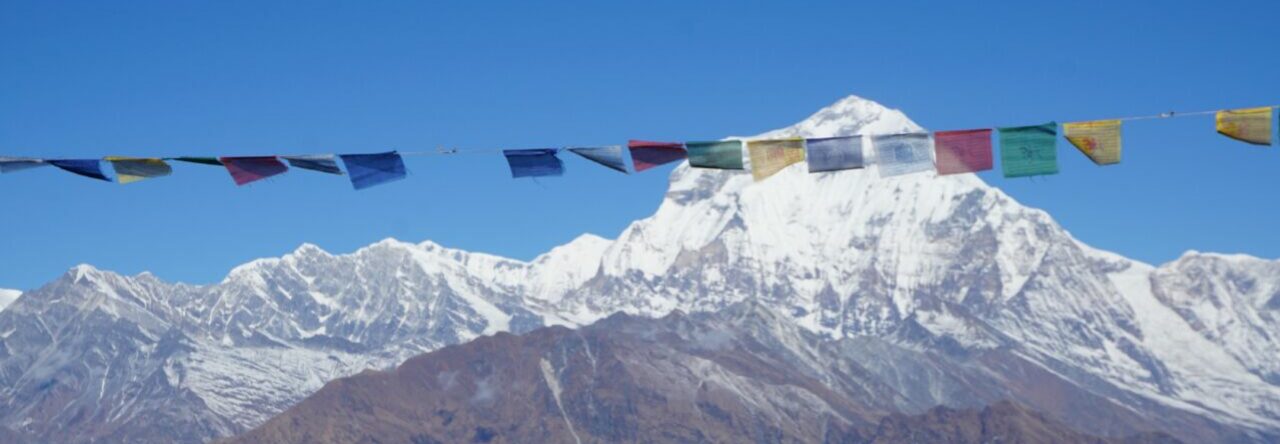
As we made our way into the hills we beheld a panorama of the world’s most famous Himalayan peaks. This is the first time since my Everest Base Camp trek in 1987 that I saw Everest, Lhotse, and the Nuptse Ridge all lined up. It was thrilling! White, crisp, clear with piercing blue skies.

Nearing our destination, we were treated to another array of stunning mountains, Numbur Mt. being the most outstanding. It seemed to follow us for the next few days.


At 6 PM we arrived in Phaplu in the Solukhumbu region, and stayed at The Everest Hotel.


Our traveling companion was a young woman, Passang, who had come to fill out the necessary documents for a student visa to study in the U.S.  She was hoping to receive a scholarship to Knox college in Illinois. Passang spoke excellent English and had a knowledge of government and history not unlike so many other young people we’d met in Nepal and India. She also knew a lot about our election and was concerned about our new president and his impact on the world stage. She wondered, also, how she would be accepted in the United States, as a foreigner.
Tomorrow our trek would begin. But tonight it’s a hearty meal and a very comfortable bed!


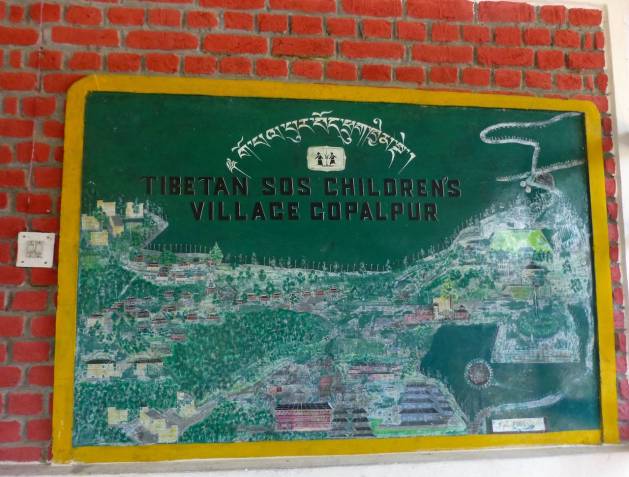
 He is thriving in this beautiful setting in the forested Himalayan foothills, and gave us an exhaustive tour of the grounds, gardens, and his living quarters. Tashi loves the pristine and immaculate ambiance of his environment, he says, and is throwing himself into his academic work with fervor. We left him as he was going for “self study” in a computer class.
 Their famous specialty, chat patri, worried me, since it was cold and had yogurt and some uncooked vegetables in it. But Cary put on her brave suit and ate every bit of it…to her delight. My loss.
 Later I was told its ingredients: fried wheat puff pastry, potatoes, yogurt, green and red sauce, a type of lentils, sweet and spicy, smooth and crunchy. And served cold. The rest of the food was a bit spicy for me, but I indulged in some of the best Indian sweets of my long life. If you’re ever in Palumpur, don’t leave without paying the Narang brothers a visit. Ashwani knows them well, also, because he buys their ice cream for his shop in Bir!
 By 3 PM we had arrived at the Suja TCV school, another favorite home away from home. The new sponsorship secretary, Tenpal, was expecting us, and we spent the rest of the evening on a sentimental exploration of the campus, noticing many changes and improvements. As always, the children greeted us warmly.


 Cary had fun sharing highlights from a Seahawks game with Tsering and Lhakpa. Tsering’s sponsor had given him a Seahawks hat (foreground) and she was explaining just who they were. Neither had ever seen football before, so it was fun to watch.


 We were so happy to see Tsering Somo again before she leaves for Canada. We shared lunch at a different Joy Cafe (that we can also recommend!) in Bir. Even a revered teacher is not immune to the hypnotic power of the cell phone!


 During our stay we watched the progress of the construction.


 As we were walking to dinner on our second day we bumped into an old friend, Thinley Gyatso, about whom I’ve written in the past. We first met him in 2011, when he was doing translation work for a Swiss NGO. Last year we visited the restaurant he had started in Dharamsala to help young Tibetan refugees get work and begin a new life in India. He just sold the restaurant and now lives near Dal Lake by the Upper Dharamsala TCV school, continuing his writing and translating. We spent a very highly charged evening of political discussions with him as well as an afternoon at his home following our first visit to the school.


 We visited with Lobsang Tenzin, the former TCV Bir sponsorship director. It was fun to see him in his new office with his two children. On the way we were delighted to bump into Ngodup Wangdu, former director of TCV Bir and now director at Dharmasala TCV.
 We met, once again, with a delightful young woman, Boshey, sponsored by Jim and Rebecca Sundberg in Langley. Boshey is taking advanced business and science, and gave us a tour of the school and her dorm. I’ve never climbed up and down so many stairs in my life, except on the Inca Trail in Peru!


 We used some of our precious rupees at a lovely handicraft store owned by a charming Indian/Kashmiri woman, Sunanda. As with so many of the businesswomen we met, she was well-informed, highly intelligent, and had a wide circle of friends around the world. Her handicrafts were lovely and one of her handwoven runners is now gracing the dining room table in Cary’s new home at Upper Langley.
 You may remember my writing about another friend I’ve known since 2011, Bilal Ahmed Gunna, who runs the Paradise Arts shop, with beautiful Kashmiri tapestries and rugs, and says that I’m the toughest bargainer he’s ever met. High praise, eh!? Here is a photo taken in 2014.
 We stopped by his shop, eager to see him again, but he was in Srinigar getting married, and his friend, Jacob, was holding down the fort. We talked for a long time with this charming gentleman, getting an overview of Indian-Kashmiri problems and the custom of arranged marriage and family life from his perspective. We live in a varied world, indeed.

 Seattle (on the Other Side) was around 175,000 and my grandson, Thomas Bixler, and my niece, Rebecca Magill, told me of the astronomical numbers crowding the streets of Washington, DC. Ditto for seventy countries around the globe. You’ve all seen the pictures and read the stories. Here are two of Rebecca, her daughter, Amaya, and husband, Paul Benzaquin.


 Omigod! Why are these robins so fat? Who has been feeding them? Surely they can’t get worms from the frozen ground. Suddenly, my mother’s words came to me: “He’s puffed up like a robin in winter.” So I looked up robins in winter (how I love the internet! Gives me such a momentary feeling of erudition). And I found out more than I ever wanted to know about them. Even when the temperature is subzero, these little creatures can puff up their feathers and increase the amount of air next to their body to insulate themselves. It can be 104 degrees under the feathers and 10 degrees outside. How about that? Nature, to me, is unbelievable in its complexity.
 Here we are at the Shechen Guest House near the Boudhanath Stupa in Kathmandu. Cary and I have just returned from a strenuous trek from Phaplu to Shivalaya in the Solukhumbu district of the Himalayas. Hooray…we survived! Hot sunny weather at midday, and freezing temperatures at night were the order of the day. You can’t beat that!


 Close by was the town spigot and washing station—a communal area where all the action was taking place. I was fascinated! It was like an open-air bathhouse with people washing feet, clothes, hair, potatoes, and pots and pans…all in cold, cold water. How I shivered when I saw naked children being bathed, but they just squealed and took it in their stride. I was loathe to photograph the bathing, due to respect for the mothers and children.


 Then we started down the hill, expecting an easy three hours to Thimbu, but, unfortunately, had to take a new trail. The usual one on the other side of the river had been badly damaged by avalanches and there was a great deal of exposure. Believe me, there was a great deal on this side, too.