…at least not from the point of view of this transplanted Yankee, unless you call fog winter. I have to admit, however, that I envied all you happy skiers and shovelers your winter wonderland. But not my theater buddy, Paul Sharar, who wasn’t even shoveling when he fell on the black ice and broke his hip. He was just leaning over to pick up the New York Times. That’s what happens when you’re an intellectual elitist! Strong guy, though. He’s already back in action. But, then, he’s from Iowa and has those strong corn-bones (sorry about that, Paul). Perhaps next year, when I’m more settled, I’ll become better acquainted with this part of the world and can head for the hills of Snoqualmie or Stevens Pass, or do some cross-country skiing close by, at Granite Falls. I’ll get the beauty without the heavy lifting!
I have a lot of catching up to do since my return from Asia in January. I stopped by New Jersey to see family and friends, and catch a few New York shows. Was hard to say goodbye to my symphony of 55 years and some of my opera and theater pals.

Terri, Bev, Phyllis, and M.P: the quadruple threat!
There’s a lot of adjusting to do when you pull up your roots after 56 years and immerse yourself in a whole new environment. For someone who gets lost going around the corner, this has been quite a challenge. But, as the old saying goes, “Change keeps you young.” It’s also the only thing you can really count on…right? Every time I take the Mukilteo ferry to the “other side” (sounds dire, doesn’t it?) I find that going 60 mph after winding around these country roads is traumatic and requires a total change of gears, figuratively speaking. There’s where all the big “box” stores are, but since I’m not a shopper, I mostly go to Seattle for cultural events, like opera and symphony. Theater you can get here on Whidbey in abundance, as well as superb music and more activities than one human being can absorb in a lifetime.
Many evenings at sunset I walk on the beach, reached by a series of stairs leading to the Sound below First Street, and watch the tide come in. I’ve never been an ocean person, so I’m loving the newness of it all.
Every day about ten emails arrive from Drew’s List, published by Drew Kampion, a beloved character around town. It’s exclusively for Whidbey Island folks. Drew sends out daily email blasts with everything from housing to entertainment, art shows to health, music of all kinds to classes promoting every form of exercise imaginable, and lost pets to help wanted. There are gardens and farms in abundance and a population that really cares for its fellow humans. My daughter, Cary, is launching a program in all the schools so the students can grow, harvest, and eat their fresh vegetables in the cafeteria. She is volunteering until funding can be found, so if you’re interested in supporting her good work, you know where to reach me! And there’s a movie theater where you get the best art films for $5.00 (if you’re old like me), and popcorn for a dollar a large bag regardless of age. Who could ask for anything more? I’ve never seen so much talent per square mile in my life, nor so many energetic, “Go-to” people. Hedgebrook Writer’s Colony for women writers is close by, but that, in itself, is too long a tale for today.
As you know from past blogs, I’m not a stranger to these parts. For years I’ve climbed every summer in the Olympic and Cascade mountains close by, and reveled in the fresh air, beauty, and peacefulness of the great Northwest. And now I’m surrounded by nature every day—a dream come true. Below are some photos I took in early February…. 


Puget Sound and the Cascade Range from Langley
…and here are a couple of shots I took today from my front deck. Flowering cherry and plum trees line the streets and paths where I walk down the hill to the post office for the mail. Yes, indeed, spring is finally here. 

There’s very little Lyme disease here on Whidbey Island, but I never pet the deer!
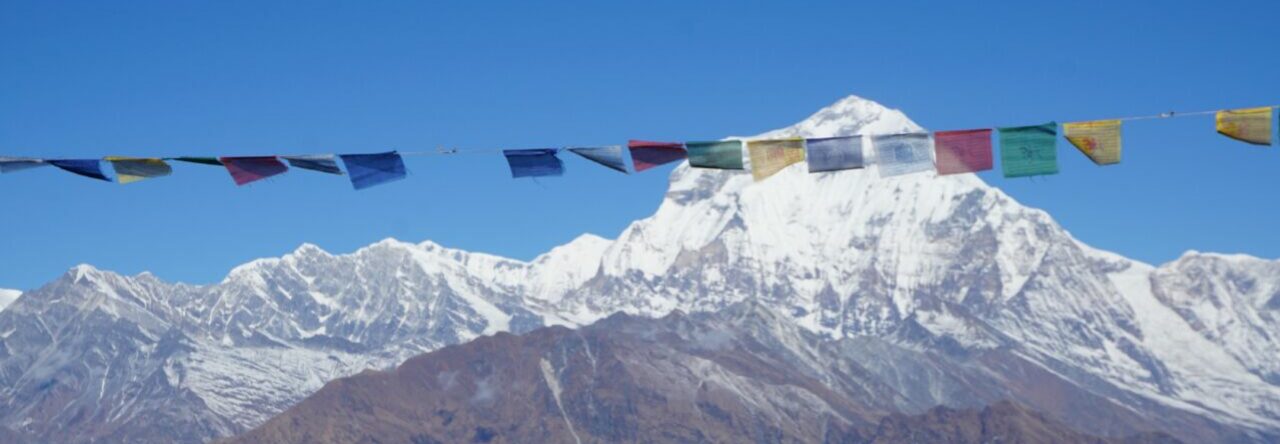
One of the many celebrations here on the island over the past two months has been Losar, the Tibetan New Year. There is a sizable sangha of practicing Buddhists in the community and here are a few photos from this recent celebration organized by the Kilung Foundation.


As I said in my last blog eons ago, I will bring you up to date on my trip to India, Bhutan, and Nepal during the year. Here I’ve started with Nepal, with a slightly different twist. No big tourist spots, just a relaxed visit to the Buddhist holy site, Boudhanath, in a non-polluted part of Kathmandu. It’s a favorite of mine. I really need a video to do justice to the traffic in Nepal, but I had enough trouble limiting my photos and placing them in order without trying to upload video files. I was verging on computer-rage before it was over!
I really fell in love with the Shechen Guest House and its staff, and was glad I could stay there for two weeks to recuperate from my nasty fall in Bhutan. In the meantime Cary went off to explore Himalayan caves in the Yolmo. Maybe I’ll get to do a trek in Mustang next year. Hope springs eternal!
I met all kinds of people in my three weeks in Nepal, and, while at the Ti-Se Guest House before going to Bhutan, spent quite a bit of time with two members of the Duggar family from Tontitown, Arkansas. I had not heard of them or seen their reality show on the TLC learning channel (don’t get me started on reality shows!). They gained fame as religious evangelists with 19 children, all of whom have been home-schooled and play a musical instrument. As a musician I really dig that! The father, Jim Bob, was here with his daughter, Jill, and a camera crew, sussing out a pen pal who turned out to be a possible suitor. The young man had been in Nepal for several year and was deep into missionary work. I asked, when I left, if they, too, were going to try to convert the Buddhists, and Jim Bob retorted, wryly, “First we have to convert you, Meg.”
I’m afraid I was rather difficult for them to figure out…a liberal minister’s daughter with a gay son and the belief that everyone is entitled to his or her beliefs, be they pantheism, agnosticism, Buddhism, or any other ism you can mention. These were nice people, but we disagreed drastically. I didn’t push my points. I never do where religion is concerned. I did shock them a bit after they talked about the “choice” of homosexuality, and the need to reverse it. That’s a rallying cry for homophobes. I simply said, “Jim Bob, I wonder if Jesus would have said ‘suffer the little children to come unto me, except for the faggots.'” Shocking, to be sure, and he took it graciously, but it did take him aback. I always thought of Jesus as inclusive. Thus endeth the lesson for today.